

Tooth Wear & Bite Reconstruction
Worn teeth are not a cosmetic problem
Teeth that have worn short are usually the visible end of a process that has also changed your bite, your jaw position and the load on everything still standing. Treating the appearance without addressing the cause guarantees it happens again.
What is actually happening
Enamel does not grow back. Once it is gone, the softer dentine underneath wears several times faster, which is why tooth wear tends to accelerate rather than progress steadily. Teeth that took twenty years to shorten by a millimetre can lose considerably more in the following five.
As the teeth shorten, the jaw closes further than it was designed to. The distance between your nose and chin reduces. That is what dentists mean by a collapsed bite or lost vertical dimension, and it is why people with advanced wear often look older than they are, with a shortened lower face and deeper lines at the corners of the mouth.
Why this matters clinically
If you rebuild worn teeth without restoring the lost height, you are building taller teeth into a space that no longer exists. They chip, they fracture, or they push the jaw somewhere it does not want to go. Restoring the vertical dimension is not an upsell, it is what makes the restorations survivable.
Three causes, and they need different answers
Most advanced cases are a combination, and identifying the dominant cause changes the treatment plan and what has to change afterwards to protect it.
This distinction is the part most often skipped. Rebuilding an erosion case without addressing the acid source, or a grinding case without a night guard, means the new restorations are exposed to exactly what destroyed the originals.
How lost height is rebuilt
Establishing where the bite should sit
Records, imaging and an assessment of how the jaw moves and where it is comfortable establish the target position. This is a measured decision rather than an estimate.
Testing it before committing
The proposed new height is trialled first, usually with provisional restorations or a removable appliance worn for a period. You eat, speak and sleep in the proposed bite, and it is adjusted based on how it performs. Muscles and the jaw joint adapt over weeks rather than instantly.
Rebuilding
Once the tested position is confirmed, the definitive restorations reproduce it. Depending on how much structure remains, this may be onlays and partial coverage restorations, full crowns, or in less advanced cases direct composite. Preserving tooth structure is prioritized wherever the loading allows it.
Protecting the result
A night guard where grinding was the driver, and management of the acid source where erosion was. This is not optional maintenance. It is the difference between a rebuild that lasts fifteen years and one that fails in three.
Case Photography
What rebuilding lost height actually looks like
Two patients with advanced wear, restored to a corrected bite. Shown with their consent.
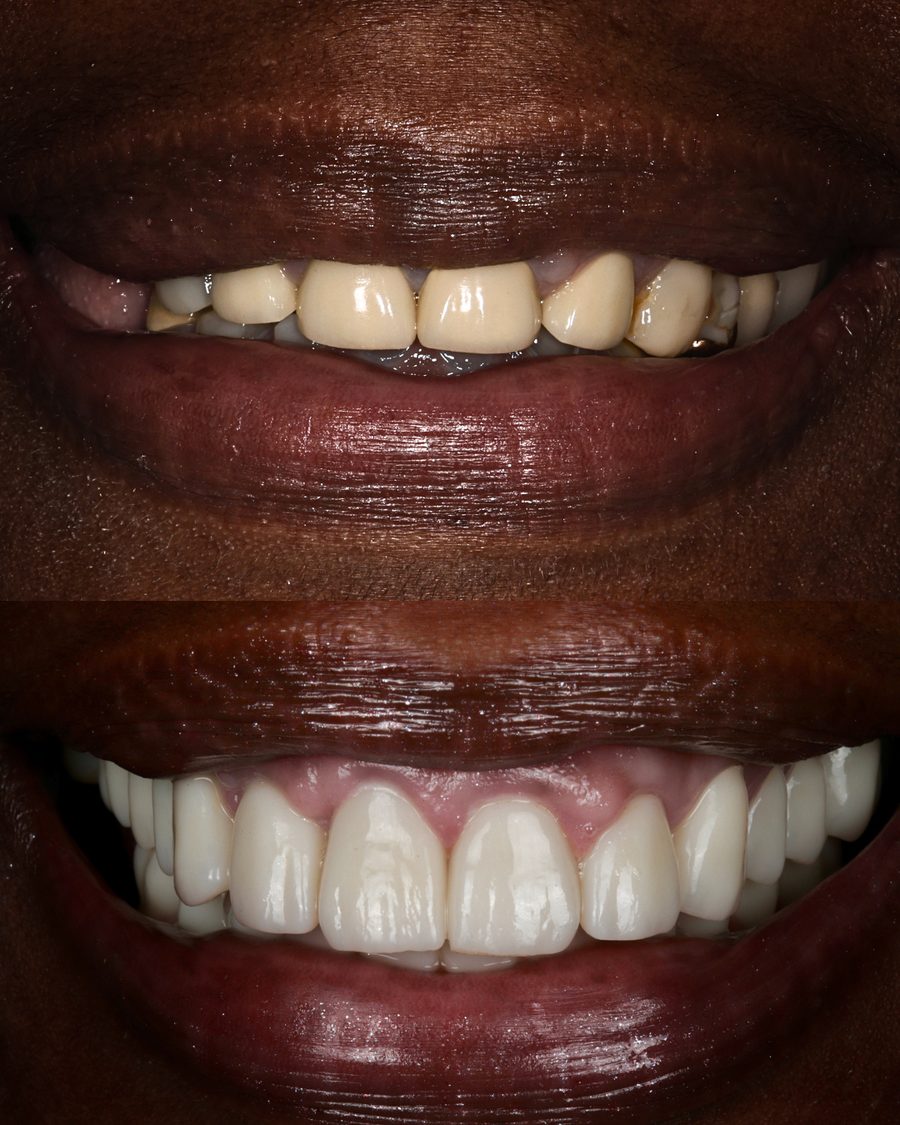 BeforeAfter
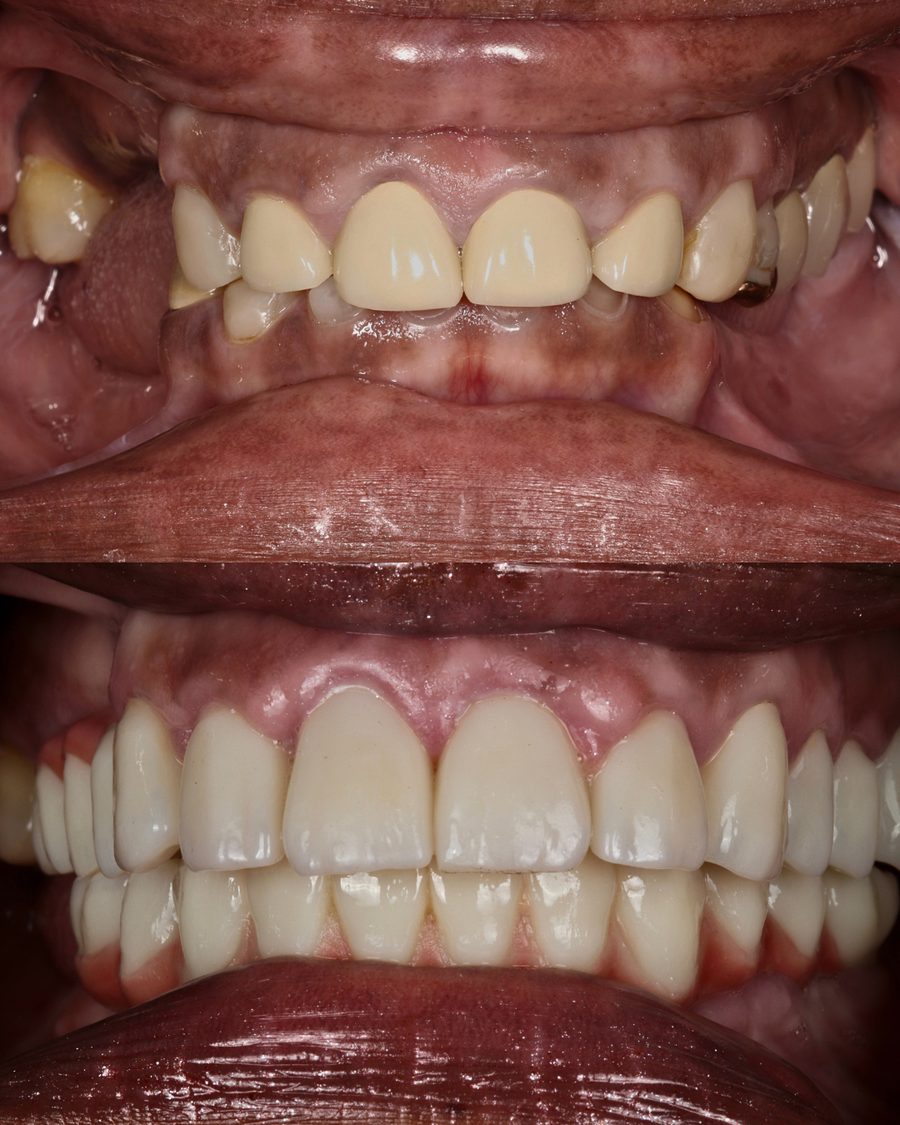 BeforeAfter
Catching it early is cheaper
Wear is one of the few dental problems where the cost curve is genuinely steep. Early intervention can often be additive, meaning material is added to the teeth without cutting them down. Advanced cases usually require full coverage restorations on many teeth.
- Front teeth looking shorter than they used to, or becoming more transparent at the edges
- Flat, shiny wear surfaces that match up with the opposing teeth
- Increasing sensitivity to cold or sweet things
- Chipping at the edges of the front teeth
- A partner mentioning grinding at night, or waking with jaw or temple soreness
- Old fillings that appear to be standing proud of the surrounding tooth, which usually means the tooth around them has worn down
If you recognize several of these
It is worth an assessment even if nothing hurts. Wear is painless for most of its course, which is precisely why it is usually addressed late. Photographic records taken now also give a baseline to measure against, which is useful even if no treatment is done yet.
Common questions
Questions patients ask most often
Can worn teeth just be built back up without crowns?
In earlier cases, frequently yes. Composite bonding added to the worn surfaces can restore shape and height without cutting the tooth, and it is reversible and considerably less expensive. It wears faster than porcelain and needs maintenance, but for a younger patient with moderate wear it is often the better first step precisely because it preserves options.
Will changing my bite feel strange?
Initially, usually yes, and that is expected. Most people adapt over two to six weeks. This is exactly why the new position is tested in provisionals first, so any difficulty adapting is discovered while the position can still be changed easily.
Will a night guard alone fix it?
A night guard prevents further wear. It does not restore what has already been lost. For someone with early wear it can be the entire treatment, and that is a good outcome. For someone whose bite has already collapsed, it protects the situation but does not correct it.
Is grinding caused by stress?
Stress is one contributor, but sleep-disordered breathing, certain medications, reflux and airway issues are all associated with nocturnal grinding. Where the pattern suggests a sleep or airway component, that is worth investigating rather than assuming stress and stopping there.
Will insurance cover it?
Coverage is generally better when the treatment is documented as functional rather than cosmetic, which is how genuine wear cases should be presented, with photographs and records showing structural loss. Annual maximums still limit what is realistically recoverable on a large case.
Find out how much has actually been lost
An assessment establishes the cause, measures what has been lost, and sets out whether this is a case for monitoring, conservative additive treatment, or a full rebuild. Many patients need considerably less than they expect.
Request a ConsultationDr. Akshay Parmar, BDS, DDS, MDSc, FACP, FAAMP. Board-certified prosthodontist, Hamilton Township, New Jersey.